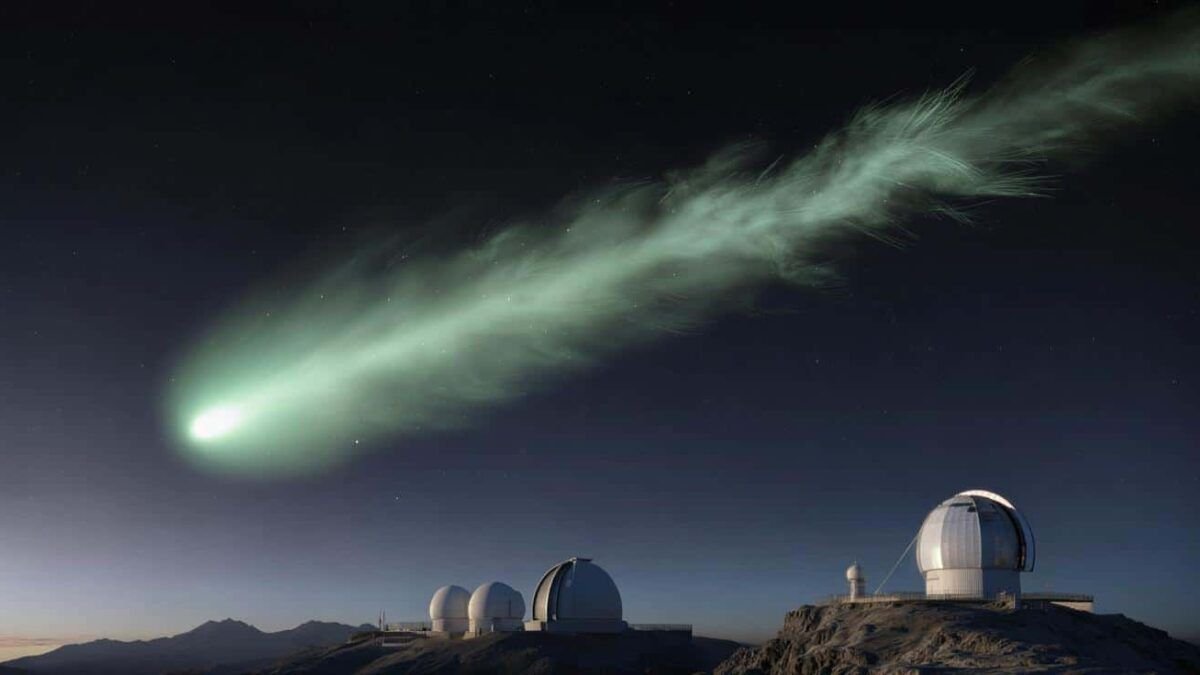
In the quiet predawn darkness of Chile, astronomers held their breath as a mesmerizing emerald streak emerged on their monitors. This ghostly tail, frayed and luminous against the void, belonged to the interstellar comet 3I ATLAS, a fleeting guest from beyond our Solar System. Captured by leading telescopes worldwide, these spectacular new images offer a front-row seat to one of the universe’s rarest spectacles, blending artistry with groundbreaking science.
From the lofty summit of Mauna Kea in Hawaii to the rugged peaks of the Canary Islands, observatories united to document this wanderer. Each vantage point and wavelength painted a fuller picture, turning a distant blur into a vibrant cosmic phenomenon. These visuals not only captivate enthusiasts but also provide astronomers with invaluable data on interstellar travelers.
Unveiling the Mysteries of Interstellar Comet 3I ATLAS
Designated as 3I ATLAS, this comet represents the third verified interstellar object to enter our cosmic backyard. Recent images from elite facilities showcase its intricate structure: a faint nucleus shrouded in a glowing green coma, followed by an expansive, twisted tail stretching across millions of kilometers. Shaped by solar winds and radiation, this tail hints at the comet’s tumultuous journey through space.
Ground-based observations elevate it from a simple streak to a detailed marvel. The Very Large Telescope (VLT) in Chile, Gemini North in Hawaii, and Gran Telescopio Canarias in La Palma reveal nuances like subtle tail distortions, suggesting interactions with interstellar medium or past gravitational encounters.
Key Features Highlighted in the Images
Astronomers on La Palma described the thrill of the first sharp image appearing during standard scans. Ultraviolet captures from Hawaii uncovered a subtle gas envelope, while infrared views pointed to unusual dust grains distinct from Solar System comets. These findings evoke the magic of ancient skywatchers witnessing something truly alien.
- Green coma: Ionized gases glowing under solar UV light.
- Warped tail: Evidence of solar pressure and possible outgassing jets.
- Hyperbolic trajectory: Confirms origins outside our Solar System, with speeds too high for capture by the Sun’s gravity.
By analyzing brightness variations and tail shapes, scientists reconstruct the comet’s path from a distant stellar nursery, offering clues about its formation billions of years ago.
The Global Race to Image 3I ATLAS
The discovery began with Hawaii’s ATLAS survey, a network of robotic telescopes hunting for near-Earth objects. What started as an unremarkable streak quickly revealed an extraordinary hyperbolic orbit, triggering a global frenzy among astronomers.
Observatories worldwide vied for observing time, coordinating across continents to maximize data collection before the comet faded from view. This high-stakes effort involved precise scheduling, specialized filters, and diverse angles to build a comprehensive dataset.
- Gemini North pivoted from deep-space galaxy hunts to track this fast-moving interloper, amid what staff called “organized pandemonium.”
- The VLT in Chile allowed observers brief moments to step outside, connecting digital feeds with the naked-eye wonder.
- Gran Telescopio Canarias leveraged its high-altitude clarity for ultra-detailed shots under optimal conditions.
Real-time collaboration through alert systems, shared databases, and late-night video calls ensured no opportunity was missed. For seasoned researchers, this event reignited the spark of discovery, merging rigorous science with pure awe at the cosmos’s unpredictability.
Scientific Insights from Multi-Wavelength Observations
Decoding the Comet’s Composition
These spectacular new images go far beyond beauty, enabling detailed spectroscopic analysis. Data from multiple sites refine the orbit, while color filters detect ices like water vapor and carbon monoxide—possibly laced with exotic molecules from its home star system.
Ongoing observations monitor activity surges as it approaches the Sun, revealing how heat triggers volatile releases and shapes the coma dynamically.
From Public Wonder to Professional Breakdowns
For the public, these visuals make “interstellar” feel real, transforming sci-fi into stunning reality. The green glow comes from excited atoms, not little green men, and the comet’s faintness underscores its profound distance traveled.
Astronomers accompany releases with educational overlays:
- Specific filter types and enhanced features.
- Current sky position and Sun distance.
- Movement rates and magnitude changes.
- Unique contributions from each observatory.
- Open puzzles for future study.
As one expert from the European Southern Observatory put it, each interstellar comet acts as a “time capsule” from another world, carrying chemical signatures impossible to obtain otherwise.
Broader Implications for Astronomy and Beyond
These captures help estimate how many interstellar objects zip through our neighborhood undetected in the past. They also probe 3I ATLAS’s backstory—perhaps a fragment from a shattered world or an ejected planetesimal.
For amateur stargazers, the images recast the night sky as a cosmic highway, where such visitors might seed our heliosphere with foreign material. Upcoming facilities like the Vera C. Rubin Observatory will amplify detections, promising a new era of interstellar astronomy.
In essence, 3I ATLAS demonstrates humanity’s growing ability to unite globally, peeling back the universe’s layers through shared passion and technology.
Why Interstellar Comet 3I ATLAS Fascinates Everyone
Its extreme rarity—unbound by our Sun, traversing voids for eons—fuels endless intrigue. Scientists marvel at billions of years of isolation, now dissected in mere weeks.
Public interest explodes with accessible visuals and stories, sparking education on key concepts:
- The porous edges of our Solar System.
- Varied chemistry in planetary building blocks across the galaxy.
- The power of modern sky surveys to rewrite horizons.
These spectacular new images do more than document; they inspire. They remind us that the cosmos whispers ancient tales through the stars, beckoning experts and dreamers alike to look up. As 3I ATLAS recedes into the interstellar dark, its portraits endure, igniting quests for tomorrow’s celestial surprises and affirming our place in an interconnected universe.
Can I see interstellar comet 3I ATLAS with my own eyes?
How do astronomers confirm 3I ATLAS is interstellar?
What makes these new images of 3I ATLAS special?
Does 3I ATLAS pose risks to Earth?
Will more interstellar objects be found soon?
