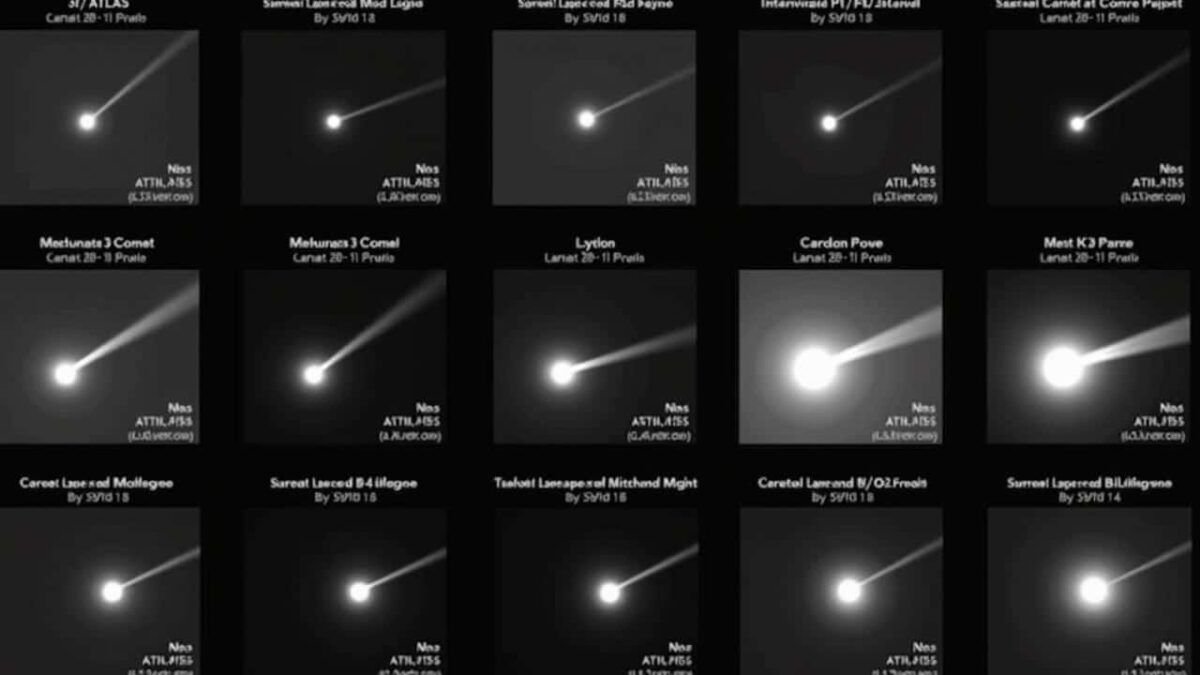
Imagine the buzz in a high-tech observatory as the first crisp images of the interstellar comet 3I/ATLAS flicker onto monitors. This elusive cosmic traveler, originating from beyond our Solar System, has been captured in unprecedented detail by eight powerhouse spacecraft, satellites, and telescopes. These groundbreaking visuals not only highlight its journey but also open a window into the mysteries of distant star systems, thrilling astronomers and space enthusiasts alike.
The release of these images marks a pivotal moment in astronomy. As 3I/ATLAS races through our cosmic neighborhood, its icy surface reacts dramatically to the Sun’s warmth, unleashing gases and dust in a mesmerizing display. This rare interstellar visitor provides invaluable data, helping scientists decode the building blocks of other planetary systems.
Unraveling the Secrets of Interstellar Comet 3I/ATLAS
At first sight, the interstellar comet 3I/ATLAS might seem like a faint, hazy spot against the stars—a subtle glow with a diffuse atmosphere and a trailing tail. It doesn’t boast the fireworks of Hollywood comets, yet its true allure lies in its extraterrestrial origin. Hurtling from the vast emptiness between stars, it has invaded our Sun’s gravitational pull on a path unlike any local resident.
This comet traces a hyperbolic orbit, a one-way ticket that guarantees it won’t loop back. Its blistering speed sets it apart from Solar System natives, making every observation a now-or-never opportunity. Experts value these encounters for the pristine samples they offer of materials untouched by our Sun for billions of years.
Previous interstellar pioneers like ‘Oumuamua and 2I/Borisov sparked endless curiosity. ‘Oumuamua baffled with its elongated form and unexpected thrust, while Borisov echoed familiar comets but at interstellar velocities. 3I/ATLAS combines elements of both, displaying classic comet features infused with alien intrigue.
Key visual hallmarks include:
- Compact nucleus: A resilient icy core holding firm against early solar heating.
- Delicate coma: A feathery envelope of gases venting as it approaches perihelion.
- sweeping tail: Streams of dust and charged particles extended by solar radiation pressure across immense distances.
The sheer improbability of detecting 3I/ATLAS amid countless interstellar nomads fuels the excitement. Perfect timing with our advanced instruments has delivered a multifaceted image dataset, like snapshots from a interstellar archive preserving clues from another star’s formative era.
The Global Teamwork Behind Multi-Instrument Observations
Capturing 3I/ATLAS required seamless international collaboration. Urgent notifications zipped through networks, rallying observatories worldwide to pivot their focus. Earth-based scopes chased optimal weather windows, while orbiting spacecraft fine-tuned their angles for prime shots.
Each of the eight platforms brought specialized prowess to the table:
- Visible-light telescopes: Outlined the comet’s core structure and surrounding haze in sharp relief.
- Infrared detectors: Revealed warm dust grains glowing beyond human vision.
-
- Ultraviolet tools: Tracked volatile outflows creating dynamic jets.
- Broad-field imagers: Charted the tail’s expanse amid the cosmic backdrop.
Precision timing was everything—some images froze the comet’s pre-closest-approach density, others hinted at emerging fragments post-perihelion. Dedicated night crews and bespoke data-processing algorithms wove disparate feeds into a unified story. Remarkably, a sharp-eyed researcher uncovered a fresh gas emission, proving the power of human insight alongside tech.
This orchestrated effort yields insights no lone observer could achieve. Merging spectral bands constructs a 3D portrait, tracking the comet’s metamorphosis from untouched relic to Sun-sculpted spectacle. It probes fundamental questions: Is this a loose aggregate or a monolithic ice block?
Interpreting the Images: Key Insights and Discoveries
These images are accessible yet profound, even for beginners. Focus on the luminous heart, the encircling glow’s reach, and the tail’s curve and grit—these elements narrate a tale of sublimating ices and stellar influences.
Context amplifies the wonder: 3I/ATLAS hauls ancient, frozen payloads thawed by alien rays. Spectral analysis uncovers organics, exotic vapors, and dust profiles that echo or defy our own comet population.
Sequential shots document dynamic shifts, like expanding envelopes and tail distortions from solar gusts. Such details illuminate distant planet-building processes and challenge assumptions about our Solar System’s exceptionalism. Truly, 3I/ATLAS acts as a galactic dispatch, ferrying whispers from far-flung realms.
Standout features from the images:
- Dust patterns: Hint at the nucleus’s rotation and surface wear.
- Gas makeup: Clues to its birth conditions light-years away.
- Path deviations: Evidence of outgassing propulsion.
Broader Impacts on Astronomy and Beyond
The saga of 3I/ATLAS connects our home turf to the galaxy’s drifters, reminding us of shared cosmic origins. Its understated beauty highlights how commonplace stuff embarks on epic voyages across voids.
These publicly shared visuals ignite public passion, urging us to ponder our place in the vastness. Upcoming sky patrols, armed with superior sensors, will unearth more such intruders routinely.
We’re entering an age where interstellar objects evolve from oddities to routine informants on exoworld debris. 3I/ATLAS pioneers this shift, broadening our grasp of stellar nurseries and ejected planetesimals.
In summary, these images are more than data points—they capture a ephemeral stellar rendezvous. As 3I/ATLAS speeds away, scientists mine every pixel for truths. It leaves us inspired: the universe teems with narratives, ripe for discovery by watchful minds. With advancing telescopes and AI-driven hunts, expect a surge of interstellar revelations, keeping the thrill of cosmic exploration alive.
What is the interstellar comet 3I/ATLAS?
How do we confirm it’s interstellar?
Why observe with eight different instruments?
Can amateurs spot 3I/ATLAS?
Will we find more interstellar objects?
